
TRUSTED ADVISOR
David G. W. Birch offers trusted advisor and board level advisory services and support for decision makers at an executive level.
David Birch is a trusted advisor to some of the biggest banks, financial services organisations, telecommunications providers and IT companies; his services sitting at the intersection of digital identity, emerging payments, and the geopolitics of money.
Drawing on the deep historical insight of Before Babylon, Beyond Bitcoin and the sharp analysis of The Currency Cold War, he helps executives, policymakers and innovators understand not just what is happening to money and identity, but why it matters.
His counsel is rooted in a simple but powerful thesis: identity is becoming the organising principle for transactions, and the institutions that grasp this shift will define the next era of financial infrastructure. Whether advising on digital credentials, CBDCs, smart wallets, or regulatory strategy, he brings a rare ability to translate complex technological change into practical, strategic decisions.



At the same time, David offers something even more valuable: context. From the identity-driven transactions of Identity is the New Money to the immersive digital economies of Money in the Metaverse, his advisory style blends economic anthropology, policy awareness and a touch of perspective to help organisations anticipate, not simply react to, structural change.
Clients rely on him for independent strategic perspective, scenario planning, and thought leadership that is as entertaining as it is incisive. In a world where AI agents, digital currencies and virtual economies are converging at speed, David acts as a trusted guide, illuminating the road ahead and ensuring his clients are not just prepared for the future, but positioned to shape it.
These trusted advisor services come in various formats, from being on the board and taking part in board meetings to facilitating workshops, debate and discussion on pertinent topics for boards, senior level executives and leadership teams. He sits on the board and acts as trusted advisor to the board for a variety of clients in the Fintech and Digital Financial Services industries including the below:








House of Lords
On 19 October 2021, David Birch gave evidence to the House of Lords Economic Affairs Committee as part of its inquiry into Central Bank Digital Currencies (CBDCs). He appeared alongside Stephen Bonner, Executive Director for Regulatory Futures and Innovation at the Information Commissioner’s Office, and Andrew Cregan, Head of Finance Policy at the British Retail Consortium. The session was chaired by Michael Forsyth, with committee members including John Monks, James Bridges, Christopher Fox and Nicholas Stern.
David argued that the key question is not whether a digital pound can be built, but what problem it is intended to solve. The UK already operates a largely digital monetary system, so a CBDC should not be treated as an inevitable technological upgrade without clearly defined policy objectives. A central theme of David’s evidence was privacy. He emphasised that privacy outcomes depend on system architecture and governance rather than the mere existence of digital money. With appropriate design choices, such as data minimisation, separation of identity from transaction data, and strong oversight, a CBDC could preserve cash-like privacy without relying on cash-like technology.
David also warned of unintended consequences for financial stability if individuals were able to hold large balances directly with the central bank, potentially disintermediating commercial banks and increasing the risk of rapid digital bank runs. Any retail CBDC would therefore require limits and an intermediated model. Placing the debate in a global context, he highlighted the competitive pressure from private, dollar-denominated stablecoins and the implications for UK monetary sovereignty. His conclusion was pragmatic: a CBDC may have a role, but only if introduced cautiously, with clear purpose, privacy by design, and safeguards that protect trust in money as a social institution.
House of Commons
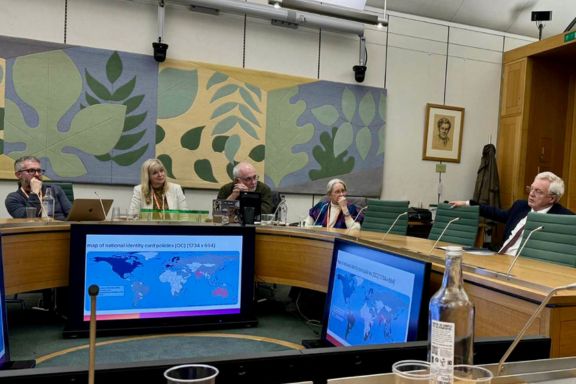
On 21st October 2025, David was invited to contribute to a debate in Porticullis House on the topic of the newly proposed government digital identity scheme along with John McDonnell MP, Eva Pascoe, James Meadway and Wendy Grossman.
David Birch argued that while the UK cannot realistically opt out of building a digital identity infrastructure, it is in danger of fighting the wrong battle. The real issue, he said, is not whether digital identity exists, but how it is designed and governed.
David rejected the notion of a centralised “digital ID card” or a system that inserts government into every transaction, instead advocating a credential-based identity infrastructure in which citizens hold cryptographically secure proofs on their own devices and disclose only what is necessary. He stressed that properly designed digital identity can increase privacy and security simultaneously, rather than trading one off against the other.
Drawing on Ukraine’s wartime experience, David noted that digital identity systems can enhance resilience and continuity of services under extreme conditions. He also widened the debate beyond civil liberties to macroeconomics, warning that if the UK fails to modernise identity and payments sensibly, convenience will drive citizens, and increasingly their AI agents, toward dollar-denominated platforms and stablecoins, with long-term consequences for monetary sovereignty.
David’s conclusion was pragmatic rather than ideological: the UK already has the foundations in the Digital Identity & Attributes Trust Framework, and progress should focus on citizen-first, privacy-preserving implementation rather than headline-driven schemes that risk repeating past failures.
HOW TO BOOK
To book David for any online or in person event, please complete the form on our Contact page, or email us direct at enquiries@dgwbirch.com.