

Agentic Commerce & Stablecoins on 3 continents
Over the last few months, Dave Birch has been on the road a lot, from Azerbaijan to the USA, focused on how agentic commerce and stablecoins are converging to redefine the future of money and financial interaction. He has explored how intelligent agents will become active participants in the economy (agentic commerce), requiring new forms of digital identity, trust, and regulation. Through his thought leadership, Dave connected the rise of stablecoins to this shift, arguing that programmable, tokenised money will power a new era of autonomous, AI-driven transactions – marking the transition from digital payments to intelligent, agent-to-agent financial ecosystems.
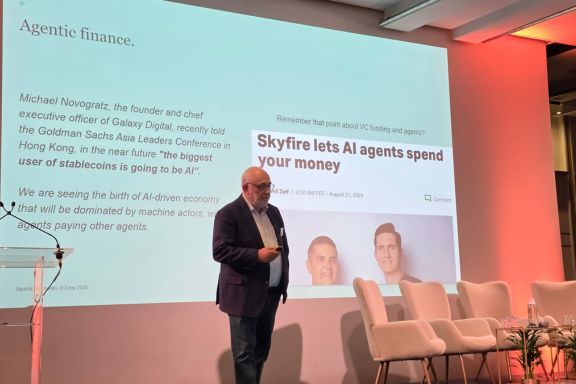
Fime Domestic Scheme Event, Paris – France
The “Agentic Payments” deck presents the emerging concept of payments made by intelligent agents – AI-driven systems capable of initiating, authorizing, and negotiating transactions independently – agentic commerce. It explores how “agentic” AI will shift financial services from human-to-machine interaction toward bot-to-bot (“R2R”) commerce, where smart wallets act as autonomous decision-makers within open finance ecosystems. The presentation outlines technological enablers like digital identity, APIs, and secure smart wallets, and frames strategic implications for banks, fintechs, and regulators as they adapt to a world where agents, not humans, are the primary payment actors.
INMerge Innovation Summit, Baku – Azerbaijan
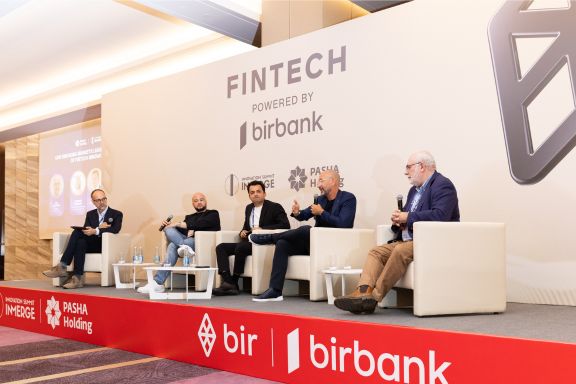
The INMerge Innovation Summit 2025 (29–30 September, Baku Convention Center) is the region’s premier platform for innovation, connecting corporates, investors, and startups from Central Eurasia and MENA to explore breakthrough technologies, forge partnerships, and accelerate cross-border growth. Organized by PASHA Bank, it showcases cutting-edge ideas in fintech, AI, and Industry 4.0, David Birch had the opportunity to be on stage there twice this year:
Panellist: Can Emerging Markets Lead the Next Wave of FinTech Innovation?
The discussion highlighted how emerging markets across Central Eurasia, the Caucasus, and MENA have a unique opportunity to leapfrog legacy infrastructure and drive the next wave of fintech innovation. With regulatory frameworks, digital identity systems, and open-finance architectures that can be redesigned more freely than in established economies, these regions have a cleaner canvas to build upon. The panel explored the complementary roles of large incumbents and agile local players who are shaping innovation through local insight, trust, and scalable partnerships. Dave Birch underscored the convergence of identity, data, money, and trust, noting that emerging markets could pioneer agentic, mobile-first financial systems that challenge traditional models. While barriers remain the key question is whether these markets can move from imitators to innovators, developing original business models like embedded finance and super-apps. The consensus: the fintech race will be won not just by technology, but by readiness, collaboration, and vision.
Moderator:
- Ilya Arkhipov – Partner, McKinsey & Company
Panellists:
- Dave Birch – Author | Advisor | Commentator, Digital Financial Services
- Godfrey Sullivan – Senior VP, Products & Solutions, CEMEA, VISA
- Giovanni Everduin – Chief Strategy & Innovation Officer, Commercial Bank International
- Samir Mammadov – CEO, PASHA Pay
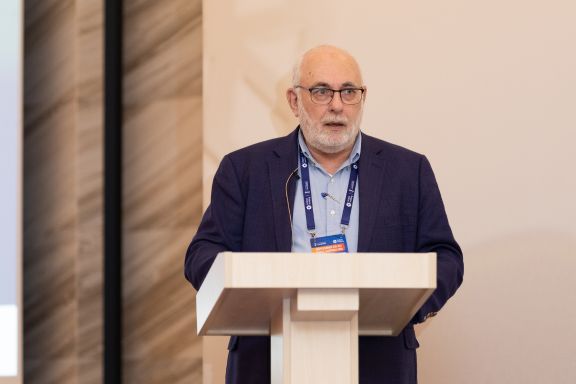
Keynote: The Real Revolution in Banking: When customers get AI,
not when institutions get AI
Dave Birch presented “The Real Revolution in Banking”, arguing that the real disruption from artificial intelligence will come not when banks deploy AI, but when customers do – agentic commerce. He described a paradigm shift in retail finance as intelligent agents – AI systems acting autonomously on behalf of consumers – become the true customers, negotiating loans, savings, and payments directly with financial institutions. David outlined how this shift demands a new digital identity framework to authenticate and authorise these non-human agents, alongside the development of digital money and infrastructure for AI-to-AI (agentic) payments. His message reframed the future of financial services: banks must prepare not to serve people with bots, but to serve the bots themselves.
Secure Cash & Transport Association Conference, Chicago – USA
The Secure Cash & Transport Association (SCTA) annual conference is a gathering of professionals from the cash-in-transit (CiT) and cash servicing industries, bringing together stakeholders such as armored transport firms, banks, retailers, ATM operators, and service providers. Secure Transport Association. The 2025 conference, held October 1-3 in Chicago under the theme “Cash in Motion: Navigating Change, Seizing Opportunity,” focused on how the cash industry is evolving amid regulatory shifts, digitisation, technological innovation and changing consumer behaviour. Delegates engaged in sessions covering topics like ATM and CiT security, regulatory developments, AI risks, retail cash processing, industry trends and networking with exhibitors showcasing the latest cash-handling technologies.
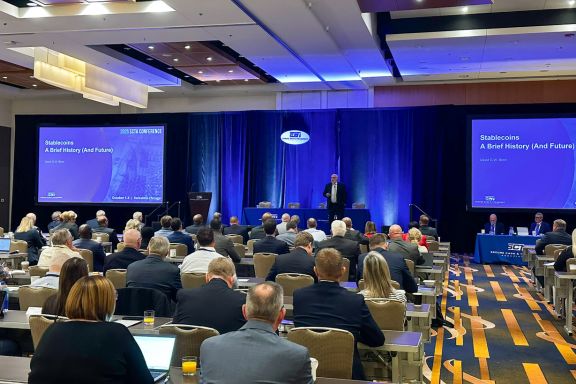
Keynote: Stablecoins from 1787-2037
In his presentation “Stablecoins: A Brief History (and Future)”, Dave Birch traced the evolution of private money from the copper tokens of 18th-century England to the digital stablecoins of today and beyond. He argued that every major technological era creates its own form of money, and that stablecoins represent the latest attempt to build currency suited to a digital, decentralized economy. Birch compared the industrial revolution’s “tradesman’s tokens,” which filled gaps left by the Royal Mint, with today’s tech-driven digital tokens issued by private enterprises to meet the needs of a new financial ecosystem. He suggested that, just as government eventually formalized and regulated those early private monies, public institutions will move to provide their own stable digital currencies. Looking ahead, Dave envisioned a future where tokenized assets and AI-driven markets form an integrated “Finternet,” ultimately leading to a world where the concept of money itself may dissolve into autonomous digital exchange.